

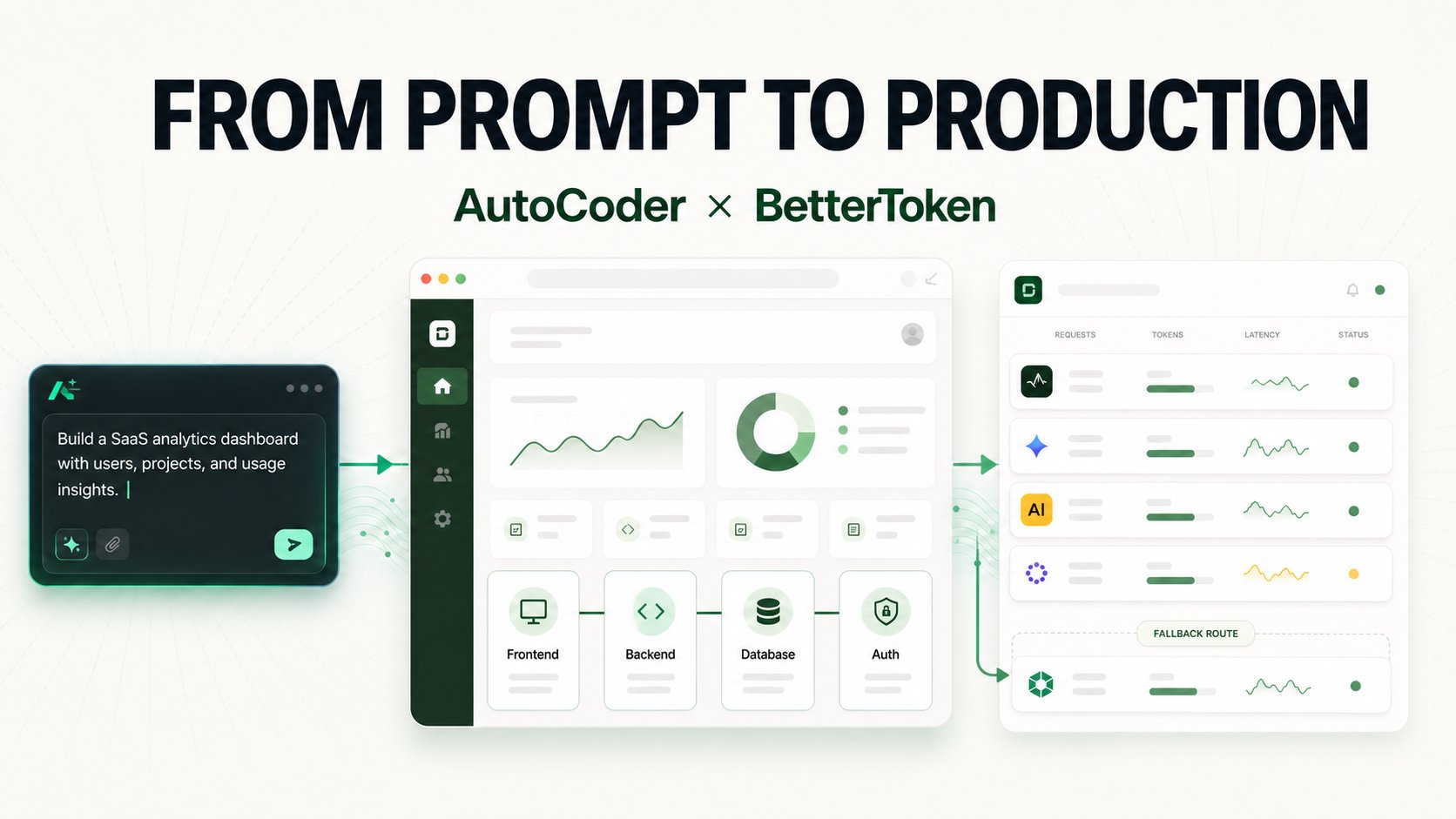
From prompt to production: solving token cost, concurrency, and multi-model API bottlenecks in AI-built apps
Introduction: Beyond the Code Generation Milestone
In today’s AI software development landscape, end-to-end platforms like AutoCoder have fundamentally accelerated the way we build software. With structured natural-language prompts, the platform autonomously synthesizes responsive frontends, backend business logic, database schemas, and authentication layers — allowing Starter, Standard and Pro plan users to export the complete full-stack source code as a ZIP archive, which can be downloaded locally and pushed to GitHub or deployed to cloud infrastructure. However, once your application is deployed and the first wave of real users arrives, many developers hit an unexpected engineering hurdle: the Model Infrastructure Bottleneck. Whether your application powers an intelligent workflow, a multi-agent system, or an AI copilot, its operational backbone relies entirely on the resilience of underlying Large Language Model (LLM) calls. If the model gateway encounters strict rate limits, unexpected latency spikes, or unmonitored token cost inflation, even the most polished UI and robust database architecture will grind to a halt. To transition AI-generated full-stack apps into resilient commercial products, engineering teams must navigate three critical production challenges.1. Three Hidden Pitfalls in AI Full-Stack Production
1. Rigid Subscription Caps and Rate Limit Roadblocks
During early prototyping, developers frequently use personal subscription keys or standard web tiers. In production, however, rigid 5-hour usage windows and tight concurrency limits quickly trigger429 Too Many Requests errors when multiple users execute parallel tasks simultaneously, breaking active sessions.
2. Token Opacity and Unpredictable Costs
In production, how many prompt tokens, completion tokens, and cached tokens does each user interaction consume? Without granular, real-time observability, teams face surprising end-of-month invoices without the ability to diagnose which agent loop or prompt template caused the token spike.3. Protocol Fragmentation and Single Point of Failure
Modern applications rarely rely on a single model. Complex reasoning may require Claude 3.7 Sonnet, lightweight classification runs best on GPT-4o-mini or DeepSeek, and specialized agents demand diverse endpoints. Managing fragmented protocol specs (Anthropic Messages API vs. OpenAI Chat Completions) while guarding against single-upstream outages introduces significant maintenance friction.2. The Architectural Solution: A Resilient API Gateway
The industry-standard pattern for production-ready AI software is introducing a dedicated API gateway layer that decouples your backend logic from raw provider endpoints. The BetterToken API Gateway provides full-stack builders with streamlined infrastructure designed for scale:- Dual-Protocol Native Compatibility: Provides dedicated OpenAI-compatible endpoints (
https://bettertoken.ai/v1) and Anthropic-compatible endpoints (https://bettertoken.ai). Switch upstream providers seamlessly by updating yourBase URLand API key without rewriting backend logic. - Pay-As-You-Go with Non-Expiring Balances: Eliminates rigid monthly seat locks. Pay strictly for verified token consumption (input, output, and cache). Purchased balances never expire at month-end, ensuring predictable capital efficiency for startups.
- Live Observability Dashboard: Monitor every request in real time — tracking timestamps, model IDs, HTTP status codes, latency, and exact token counts (input/output/cache) directly within your console.
- Intelligent Routing & Automatic Fallback: Built-in routing dynamically directs traffic across verified channels, offering automatic failover when configured multi-upstream channels experience transient timeouts or upstream disruption.
Architecture Comparison: Direct Provider Binding vs. Unified Gateway Architecture
3. Practical Implementation: Configuring AutoCoder-Exported Backends
For a standard Node.js (TypeScript) backend exported from AutoCoder, connecting to BetterToken requires only setting standard environment variables.1. Environment Configuration (.env)
2. Backend Service Integration (Node.js)
baseURL to the gateway, your production application inherits high-concurrency elasticity, transparent cost accounting, and resilient request routing without altering core business workflows.
4. Scaling Up: Establishing Token Cost Observability
As your application transitions from launch to scale, continuous cost governance becomes essential for maintaining healthy gross margins:- Leverage Prompt Caching: For agents and apps handling persistent system prompts or large context windows, monitor cache read tokens to reduce high-frequency invocation costs.
- Immediate Error Diagnosis: Track HTTP status codes in your dashboard. Isolate 4xx/5xx errors instantly by correlating timestamps and request IDs with your application logs.
- Dynamic Model Allocation: Review current model rates and availability in real time via the BetterToken Pricing Directory to assign cost-efficient models for standard utility tasks and top-tier models for complex workflows.
5. Conclusion and Action Path
Generating full-stack applications with AutoCoder eliminates the traditional barrier between concept and code. Pairing that speed with a transparent, resilient, and high-concurrency model infrastructure ensures your application thrives under production traffic.Get Started (Actionable CTA): To eliminate rigid subscription limits and gain full visibility over your application’s token economics, connect your backend to the pay-as-you-go BetterToken API Gateway — monitor live response latency and token usage directly from your dashboard.