> ## Documentation Index
> Fetch the complete documentation index at: https://docs.autocoder.cc/docs/llms.txt
> Use this file to discover all available pages before exploring further.
# Web Data Extraction Workflow Playbook
> Plan web data extraction with appropriate source choices, validation, monitoring, and controls for a maintainable internal workflow.
*Published September 23, 2026*
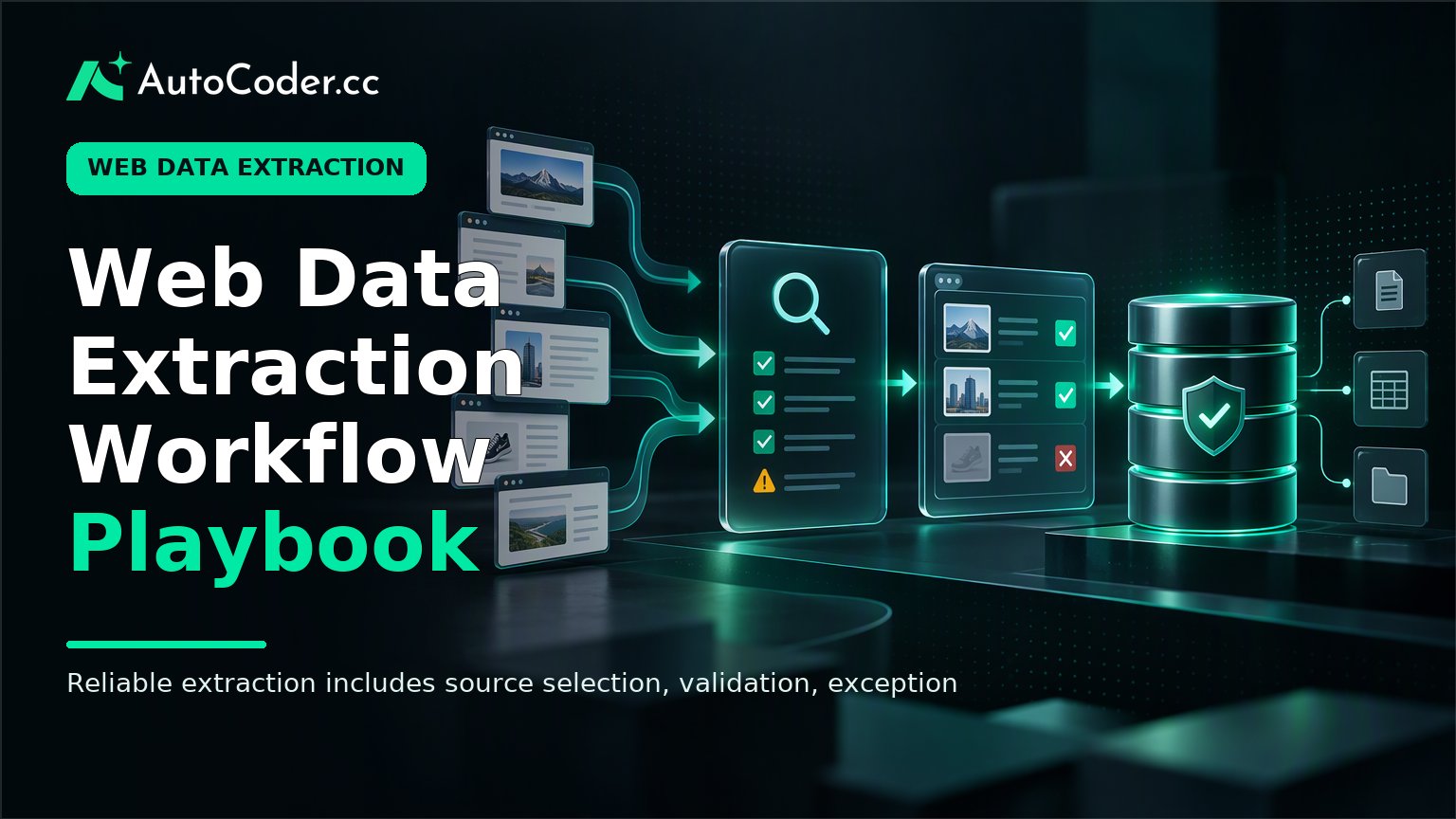 **Web data extraction** should be designed as an operating process, not treated as a one-time technical task. Product teams, analysts, and founders need to define the information required, assess whether a source can be used appropriately, validate what is collected, and decide who responds when a source or its access conditions change.
A reliable approach starts with a narrow data requirement. Teams can then choose a suitable collection method, build controlled processing and review steps, and maintain a traceable internal dataset. This makes automated collection easier to operate and reduces the risk that raw, incomplete, or unsuitable records flow into a product decision or report.
## Define the data need before selecting a source
Start with the decision the data must support, then specify only the fields needed to support it. A source is useful when its information is relevant, accessible through an appropriate route, and reliable enough for the intended use—not simply because it contains a large amount of content.
Web data extraction is the process of converting information from web-accessible sources into structured records that can be reviewed, stored, and used in a system. Sources may include web pages, official APIs, downloadable files, form submissions, or manually maintained datasets. The output may be a database update, a review queue, a table, or a report.
The term overlaps with web scraping, but they are not identical. Web scraping commonly means programmatically retrieving and parsing page content. Web data extraction is broader: it can include API retrieval, file imports, page parsing, and manual review where automation would be inappropriate or unreliable.
Before evaluating a web data scraper or writing collection logic, document these prerequisites:
* **Purpose:** State the product, research, operational, or reporting question the records will answer.
* **Fields:** List required and optional attributes, expected formats, and acceptable missing values.
* **Scope:** Identify source types, page types, regions, languages, and dates that are in scope.
* **Freshness:** Decide whether the data is needed once, on a schedule, or after a source update.
* **Users:** Identify who may view, edit, approve, export, or act on the records.
For example, a team reviewing public product documentation may need a title, URL, update indicator where available, extraction time, and a normalized topic. It does not necessarily need every page element or unrelated information on the source. A small, explicit schema makes parsing rules, validation, and later maintenance more manageable.
This step can also show that web collection is unnecessary. An internal database, partner feed, or source-provided export may answer the same question with less maintenance than page extraction.
## Check access, terms, and data responsibilities first
Treat source access and data handling as workflow requirements from the beginning. Before automated data collection begins, determine whether the source provides a permitted route to the information and whether the planned use introduces legal, contractual, privacy, or operational responsibilities.
Review the source's terms, access conditions, and relevant robots directives. Robots directives can signal preferences to automated clients, but they do not replace a review of terms, applicable law, or contractual obligations. If the use case remains unclear, obtain appropriate legal or policy guidance for the organization and jurisdiction involved.
A practical source assessment should answer the following questions:
1. **Is there an official method?** Look for an API, downloadable dataset, feed, or approved export before considering page parsing.
2. **What use is allowed?** Record restrictions concerning redistribution, commercial use, caching, attribution, request volume, or derivative datasets.
3. **Does collection require a login?** Do not bypass authentication, paywalls, rate limits, or other technical controls. Use authorized accounts only where the service permits the intended activity.
4. **What kind of information is involved?** Avoid collecting sensitive personal information unless there is a clear authorized purpose and an appropriate handling process.
5. **Could the workflow burden the source?** Use restrained request behavior, avoid unnecessary repeat collection, and stop failing jobs rather than retrying indefinitely.
6. **How long will data be retained?** Define retention, deletion, and access controls before records enter a shared system.
Public visibility does not necessarily mean unrestricted reuse. Keep a record of the source, access route, collection date, and internal decision about its intended use. That documentation supports later review if a workflow expands, a source owner changes terms, or a team wants to publish data beyond its original purpose.
Avoid making page extraction the only route to a critical operational dataset. If a source changes structure or becomes unavailable, the team should know what depends on it and what temporary fallback is available.
## Choose the web data extraction method that fits the source
Prefer the most stable and clearly authorized format that supplies the required fields. A good data extraction workflow may combine several methods instead of forcing every source through the same web scraping process.
**Official APIs** are often the clearest option when they provide the needed fields under acceptable terms. They may offer documented authentication and more predictable response structures. Their limitations can include approval requirements, usage rules, incomplete coverage, or a format that does not match the internal data model.
**Downloadable datasets and exports** can suit scheduled updates and historical files. They are often easier to archive and inspect, but update frequency may be limited, file schemas can change, and content still requires validation before merging.
**Page extraction** can be appropriate when no suitable feed or export exists and access is permitted. It requires parsing rules that isolate intended content while excluding navigation, duplicated text, layout elements, and unrelated modules. Since page structures can change without notice, this method needs close monitoring.
**Manual collection or review** is appropriate for low-volume, ambiguous, or high-consequence information. It is slower, but it can prevent brittle automation from making incorrect assumptions. A hybrid approach can automatically collect candidates and send uncertain records to a reviewer.
Use this selection sequence:
1. Compare the source options against the required fields and freshness needs.
2. Check permitted use, authentication requirements, stability, and expected maintenance work.
3. Select an API or export when it adequately meets the need.
4. Use page extraction only where it is appropriate and there is no better permitted route.
5. Document the chosen method, source owner, fallback process, and validation rules.
A web data scraper is therefore only one component of the workflow. It may retrieve page content, but the broader process must normalize records, retain source context, detect failures, and prevent unsuitable output from reaching downstream users.
## Design a reliable data extraction workflow
**Web data extraction** should be designed as an operating process, not treated as a one-time technical task. Product teams, analysts, and founders need to define the information required, assess whether a source can be used appropriately, validate what is collected, and decide who responds when a source or its access conditions change.
A reliable approach starts with a narrow data requirement. Teams can then choose a suitable collection method, build controlled processing and review steps, and maintain a traceable internal dataset. This makes automated collection easier to operate and reduces the risk that raw, incomplete, or unsuitable records flow into a product decision or report.
## Define the data need before selecting a source
Start with the decision the data must support, then specify only the fields needed to support it. A source is useful when its information is relevant, accessible through an appropriate route, and reliable enough for the intended use—not simply because it contains a large amount of content.
Web data extraction is the process of converting information from web-accessible sources into structured records that can be reviewed, stored, and used in a system. Sources may include web pages, official APIs, downloadable files, form submissions, or manually maintained datasets. The output may be a database update, a review queue, a table, or a report.
The term overlaps with web scraping, but they are not identical. Web scraping commonly means programmatically retrieving and parsing page content. Web data extraction is broader: it can include API retrieval, file imports, page parsing, and manual review where automation would be inappropriate or unreliable.
Before evaluating a web data scraper or writing collection logic, document these prerequisites:
* **Purpose:** State the product, research, operational, or reporting question the records will answer.
* **Fields:** List required and optional attributes, expected formats, and acceptable missing values.
* **Scope:** Identify source types, page types, regions, languages, and dates that are in scope.
* **Freshness:** Decide whether the data is needed once, on a schedule, or after a source update.
* **Users:** Identify who may view, edit, approve, export, or act on the records.
For example, a team reviewing public product documentation may need a title, URL, update indicator where available, extraction time, and a normalized topic. It does not necessarily need every page element or unrelated information on the source. A small, explicit schema makes parsing rules, validation, and later maintenance more manageable.
This step can also show that web collection is unnecessary. An internal database, partner feed, or source-provided export may answer the same question with less maintenance than page extraction.
## Check access, terms, and data responsibilities first
Treat source access and data handling as workflow requirements from the beginning. Before automated data collection begins, determine whether the source provides a permitted route to the information and whether the planned use introduces legal, contractual, privacy, or operational responsibilities.
Review the source's terms, access conditions, and relevant robots directives. Robots directives can signal preferences to automated clients, but they do not replace a review of terms, applicable law, or contractual obligations. If the use case remains unclear, obtain appropriate legal or policy guidance for the organization and jurisdiction involved.
A practical source assessment should answer the following questions:
1. **Is there an official method?** Look for an API, downloadable dataset, feed, or approved export before considering page parsing.
2. **What use is allowed?** Record restrictions concerning redistribution, commercial use, caching, attribution, request volume, or derivative datasets.
3. **Does collection require a login?** Do not bypass authentication, paywalls, rate limits, or other technical controls. Use authorized accounts only where the service permits the intended activity.
4. **What kind of information is involved?** Avoid collecting sensitive personal information unless there is a clear authorized purpose and an appropriate handling process.
5. **Could the workflow burden the source?** Use restrained request behavior, avoid unnecessary repeat collection, and stop failing jobs rather than retrying indefinitely.
6. **How long will data be retained?** Define retention, deletion, and access controls before records enter a shared system.
Public visibility does not necessarily mean unrestricted reuse. Keep a record of the source, access route, collection date, and internal decision about its intended use. That documentation supports later review if a workflow expands, a source owner changes terms, or a team wants to publish data beyond its original purpose.
Avoid making page extraction the only route to a critical operational dataset. If a source changes structure or becomes unavailable, the team should know what depends on it and what temporary fallback is available.
## Choose the web data extraction method that fits the source
Prefer the most stable and clearly authorized format that supplies the required fields. A good data extraction workflow may combine several methods instead of forcing every source through the same web scraping process.
**Official APIs** are often the clearest option when they provide the needed fields under acceptable terms. They may offer documented authentication and more predictable response structures. Their limitations can include approval requirements, usage rules, incomplete coverage, or a format that does not match the internal data model.
**Downloadable datasets and exports** can suit scheduled updates and historical files. They are often easier to archive and inspect, but update frequency may be limited, file schemas can change, and content still requires validation before merging.
**Page extraction** can be appropriate when no suitable feed or export exists and access is permitted. It requires parsing rules that isolate intended content while excluding navigation, duplicated text, layout elements, and unrelated modules. Since page structures can change without notice, this method needs close monitoring.
**Manual collection or review** is appropriate for low-volume, ambiguous, or high-consequence information. It is slower, but it can prevent brittle automation from making incorrect assumptions. A hybrid approach can automatically collect candidates and send uncertain records to a reviewer.
Use this selection sequence:
1. Compare the source options against the required fields and freshness needs.
2. Check permitted use, authentication requirements, stability, and expected maintenance work.
3. Select an API or export when it adequately meets the need.
4. Use page extraction only where it is appropriate and there is no better permitted route.
5. Document the chosen method, source owner, fallback process, and validation rules.
A web data scraper is therefore only one component of the workflow. It may retrieve page content, but the broader process must normalize records, retain source context, detect failures, and prevent unsuitable output from reaching downstream users.
## Design a reliable data extraction workflow
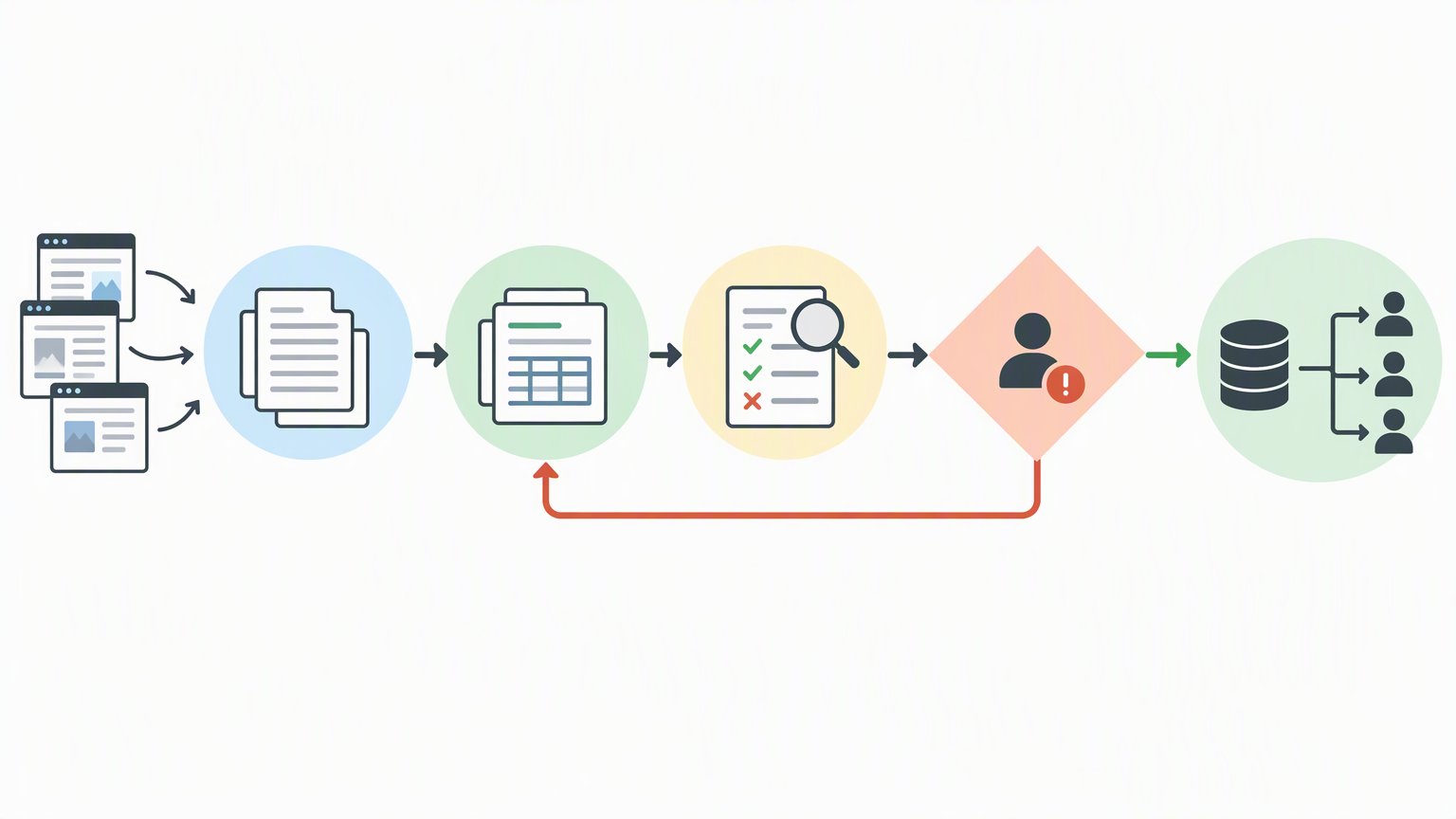 Build the workflow around traceable records and explicit failure paths. The objective is not simply to collect content, but to produce records another team member can understand, verify, and safely use later.
Follow these implementation steps:
1. **Create a source registry.** For each source, record its base URL or endpoint, approved access route, owner, purpose, field mapping, schedule, permitted-use notes, and last review date. 2. **Define an input queue.** Capture the URLs, identifiers, search terms, or API parameters that start each run. Validate inputs before collection to exclude malformed URLs, unsupported page types, and duplicates. 3. **Collect with controlled behavior.** Retrieve only what the schema requires. Set timeouts, bounded retries, and a clear stop condition. Store the collection time, source reference, method, and outcome for every attempt. 4. **Parse and normalize fields.** Convert source-specific formats into a consistent model. Preserve original text where useful, standardize dates, and use controlled category values. Do not silently replace missing values with guesses. 5. **Validate before publishing.** Check required fields, allowed values, duplicates, unexpected format changes, and relevant relationships between fields. A sudden absence of a normally present field may indicate a broken parser. 6. **Route exceptions to review.** Separate incomplete, ambiguous, and structurally changed records from records that pass validation. Reviewers need the source reference, extracted value, failed rule, and a clear action such as correct, approve, discard, or defer. 7.
Where feasible, separate raw, normalized, and published layers. Raw responses support debugging within the retention policy. Normalized records support checks and correction. Published data gives internal users a stable view without exposing unreviewed values or implementation detail.
## Build an internal application around clear controls
Build the workflow around traceable records and explicit failure paths. The objective is not simply to collect content, but to produce records another team member can understand, verify, and safely use later.
Follow these implementation steps:
1. **Create a source registry.** For each source, record its base URL or endpoint, approved access route, owner, purpose, field mapping, schedule, permitted-use notes, and last review date. 2. **Define an input queue.** Capture the URLs, identifiers, search terms, or API parameters that start each run. Validate inputs before collection to exclude malformed URLs, unsupported page types, and duplicates. 3. **Collect with controlled behavior.** Retrieve only what the schema requires. Set timeouts, bounded retries, and a clear stop condition. Store the collection time, source reference, method, and outcome for every attempt. 4. **Parse and normalize fields.** Convert source-specific formats into a consistent model. Preserve original text where useful, standardize dates, and use controlled category values. Do not silently replace missing values with guesses. 5. **Validate before publishing.** Check required fields, allowed values, duplicates, unexpected format changes, and relevant relationships between fields. A sudden absence of a normally present field may indicate a broken parser. 6. **Route exceptions to review.** Separate incomplete, ambiguous, and structurally changed records from records that pass validation. Reviewers need the source reference, extracted value, failed rule, and a clear action such as correct, approve, discard, or defer. 7.
Where feasible, separate raw, normalized, and published layers. Raw responses support debugging within the retention policy. Normalized records support checks and correction. Published data gives internal users a stable view without exposing unreviewed values or implementation detail.
## Build an internal application around clear controls
 Use the internal application to operate the workflow, not merely display collected records. Teams often need controlled inputs, visible job status, review queues, permissions, and an audit trail alongside the dataset.
Start by mapping a source registry, collection-request form, job-status view, record-review queue, and searchable approved dataset. Each screen should reflect a workflow responsibility. An analyst might submit a permitted source and resolve exceptions, while an administrator manages credentials or schedules.
The application should support editable source and field definitions, role-based permissions, source references and validation results, understandable job states, and a way to pause a source when access conditions change or parsing fails. Keep credentials out of user-facing forms, keep collection logic on the server side, and do not make raw output the default dataset.
Teams building a tailored operational tool can use [AutoCoder's AI app builder](https://www.autocoder.cc/platform?utm_source=blog\&utm_medium=latest\&utm_campaign=WebDataExtraction) to generate an editable full-stack starting point from product requirements. The resulting application still needs approved source methods, validation rules, and a named operational owner.
## Maintain data quality over time
Assign an owner and review cadence to every active source. Extraction logic can degrade when page structures, access methods, terminology, or business requirements change, so maintenance belongs in the original plan.
Review source health after unusual outcomes and on a regular schedule. Check whether required fields remain present, whether results are unexpectedly empty or unusually large, whether duplicates have changed, and whether terms or access routes have been updated. These are investigation signals, not proof that records are wrong.
Version parsing and transformation changes. When a field rule changes, retain enough context to distinguish records created under the earlier rule from those created under the newer one. Test changed connectors against representative permitted inputs before returning them to scheduled collection.
Document who owns each source relationship, who approves schema changes, who responds to failed jobs, and who decides whether a dataset remains fit for use. Clear ownership is especially important when records support material product, operational, or reporting decisions.
## FAQ
### What is web data extraction?
Web data extraction is the process of collecting information from web-accessible sources and converting it into structured records. It can involve APIs, downloads, page parsing, or manual review, depending on the source and intended use.
### Is web data extraction legal?
It depends on the source, access method, intended use, applicable law, contractual terms, and data involved. Review source conditions and seek appropriate guidance where needed. Do not bypass access controls or collect sensitive personal data without a clear authorized basis.
### What is the difference between web scraping and using an API?
Web scraping generally parses page content, while an API provides a defined interface for requesting data. An API may be more stable and clearly governed when it supplies the required fields. Page extraction can require more maintenance because page structures may change.
### How can I automate web data extraction?
Define fields and approved sources, select an appropriate access method, collect on a controlled schedule, validate records, route exceptions for review, and monitor failures. Automation needs pause and correction paths rather than an assumption that every run is correct.
## Conclusion
Reliable **web data extraction** starts with a narrow data purpose and continues through source review, controlled collection, validation, provenance, and ongoing ownership. Prefer permitted, stable formats such as APIs or exports when they meet the need, use page extraction carefully where appropriate, and keep raw collection separate from approved output. These controls make the workflow easier to maintain, review, and adapt when sources change.
This documentation is built and hosted on [Mintlify](https://mintlify.com), a developer documentation platform.
Use the internal application to operate the workflow, not merely display collected records. Teams often need controlled inputs, visible job status, review queues, permissions, and an audit trail alongside the dataset.
Start by mapping a source registry, collection-request form, job-status view, record-review queue, and searchable approved dataset. Each screen should reflect a workflow responsibility. An analyst might submit a permitted source and resolve exceptions, while an administrator manages credentials or schedules.
The application should support editable source and field definitions, role-based permissions, source references and validation results, understandable job states, and a way to pause a source when access conditions change or parsing fails. Keep credentials out of user-facing forms, keep collection logic on the server side, and do not make raw output the default dataset.
Teams building a tailored operational tool can use [AutoCoder's AI app builder](https://www.autocoder.cc/platform?utm_source=blog\&utm_medium=latest\&utm_campaign=WebDataExtraction) to generate an editable full-stack starting point from product requirements. The resulting application still needs approved source methods, validation rules, and a named operational owner.
## Maintain data quality over time
Assign an owner and review cadence to every active source. Extraction logic can degrade when page structures, access methods, terminology, or business requirements change, so maintenance belongs in the original plan.
Review source health after unusual outcomes and on a regular schedule. Check whether required fields remain present, whether results are unexpectedly empty or unusually large, whether duplicates have changed, and whether terms or access routes have been updated. These are investigation signals, not proof that records are wrong.
Version parsing and transformation changes. When a field rule changes, retain enough context to distinguish records created under the earlier rule from those created under the newer one. Test changed connectors against representative permitted inputs before returning them to scheduled collection.
Document who owns each source relationship, who approves schema changes, who responds to failed jobs, and who decides whether a dataset remains fit for use. Clear ownership is especially important when records support material product, operational, or reporting decisions.
## FAQ
### What is web data extraction?
Web data extraction is the process of collecting information from web-accessible sources and converting it into structured records. It can involve APIs, downloads, page parsing, or manual review, depending on the source and intended use.
### Is web data extraction legal?
It depends on the source, access method, intended use, applicable law, contractual terms, and data involved. Review source conditions and seek appropriate guidance where needed. Do not bypass access controls or collect sensitive personal data without a clear authorized basis.
### What is the difference between web scraping and using an API?
Web scraping generally parses page content, while an API provides a defined interface for requesting data. An API may be more stable and clearly governed when it supplies the required fields. Page extraction can require more maintenance because page structures may change.
### How can I automate web data extraction?
Define fields and approved sources, select an appropriate access method, collect on a controlled schedule, validate records, route exceptions for review, and monitor failures. Automation needs pause and correction paths rather than an assumption that every run is correct.
## Conclusion
Reliable **web data extraction** starts with a narrow data purpose and continues through source review, controlled collection, validation, provenance, and ongoing ownership. Prefer permitted, stable formats such as APIs or exports when they meet the need, use page extraction carefully where appropriate, and keep raw collection separate from approved output. These controls make the workflow easier to maintain, review, and adapt when sources change.
This documentation is built and hosted on [Mintlify](https://mintlify.com), a developer documentation platform.